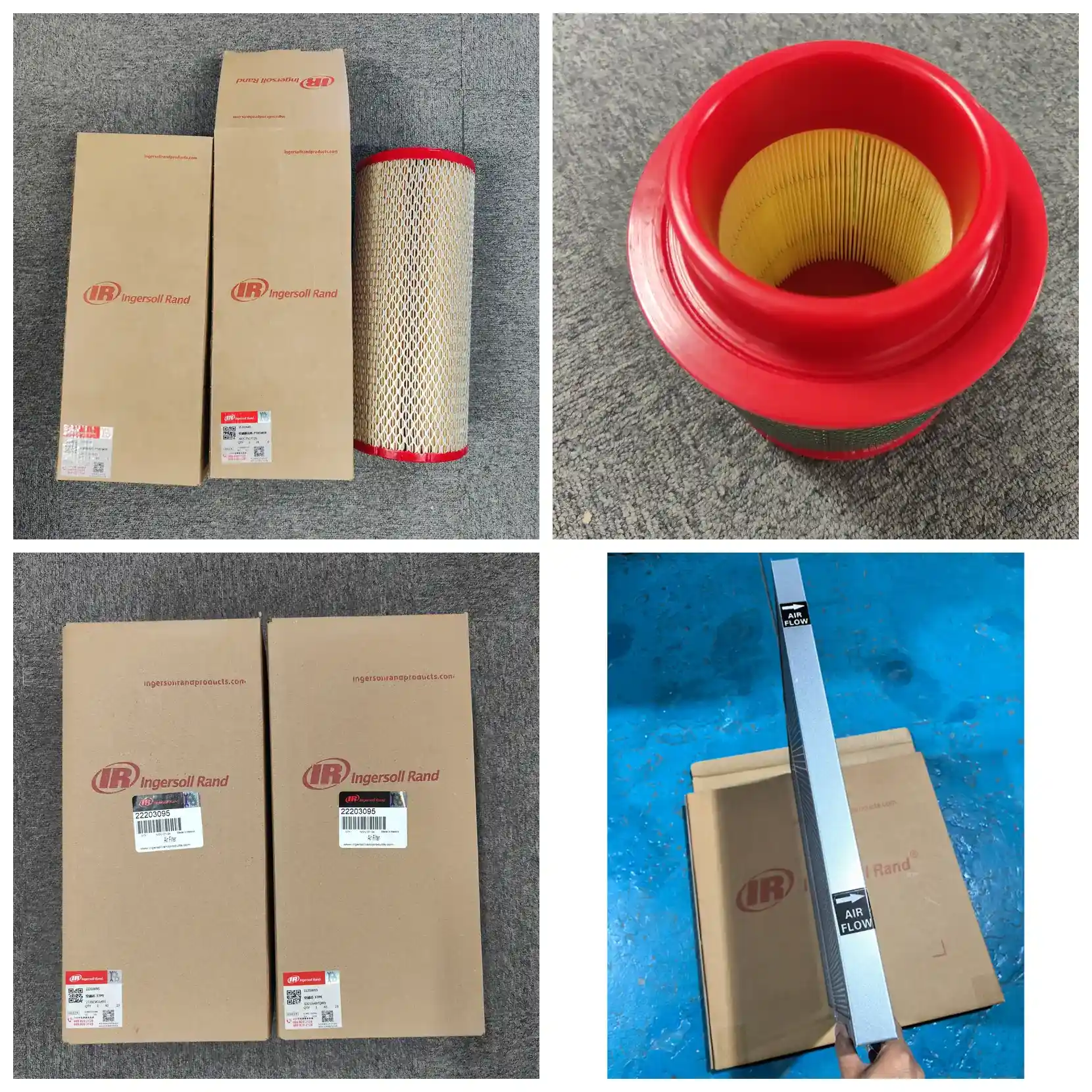
Product
Ingersoll Rand 47557738001 Standard Air Filter | RS45i/RS55i/RS75i
Ingersoll Rand 47557738001 standard air filter element for RS45i, RS55i, and RS75i rotary screw compressors. 4000-hour service interval under standard conditions. Not for IE/NE suffix models or high-dust configurations (use 24900318).
- Export packaging & documentation support
- OEM / ODM customization available
- Sample and bulk order workflow
1. Product Overview
47557738001 is the standard intake air filter element used on Ingersoll Rand RS45i, RS55i, and RS75i rotary screw compressors. The English name in the parts manual is ELEMENT, AIR FILTER (STANDARD).
It is located after the compressor intake and before the main air inlet valve. Outside air passes through it first, then enters the compression chamber. If dust particles enter the compressor directly, they wear the rotor and casing clearance. Once the clearance increases, compression efficiency drops irreversibly. The air filter element guards this critical point.
For these three models, two intake configurations exist: standard and high-dust. This part is the standard type, part number 47557738001; the high-dust configuration uses a different part number, 24900318. The two look similar and installing the wrong one will not trigger an immediate fault, but in dusty sites the standard element will clog prematurely, significantly shortening the replacement interval. Always check site conditions before selecting the part number.
Another common pitfall: this part number does not apply to units with IE or NE suffixes. RS45i, RS45ie, and RS45ne are different configurations, and intake parts are not interchangeable.
2. Basic Specifications
| Item | Details |
|---|---|
| Part Number | 47557738001 |
| English Name | ELEMENT, AIR FILTER (STANDARD) |
| Chinese Name | Standard Air Filter Element (Standard Intake Filter) |
| Brand | Ingersoll Rand |
| Part Type | Intake filtration consumable, complete replacement |
| Compatible Models | RS45i, RS55i, RS75i |
| Incompatible Models | Units with IE / NE suffix; high-dust configuration units (use 24900318) |
| Installation Location | Between intake and main air inlet valve |
| Replacement Interval | 4000 hours under standard conditions; earlier in dusty environments based on differential pressure |
3. Technical Specifications
3.1 Filtration Performance (Core Metrics)
| Parameter | Value / Description |
|---|---|
| Filtration Rating | Approx. 3–10 μm, primarily intercepting particles above 10 μm |
| Filtration Efficiency | ≥99% (standard test dust, rated airflow) |
| Filter Class | Intake pre-filtration grade, characterized by efficiency and dust holding capacity; HVAC classification (G4 / F7 etc.) not applicable |
| Dust Holding Capacity | Typically 200–400 g for similar parts; exact value per incoming inspection or manufacturer data |
| Cleanable / Reusable | Not recommended. Paper media fibers collapse after water washing, reducing both dust holding capacity and efficiency |
These figures help determine whether to replace and whether the correct grade was purchased; they are not acceptance criteria. For acceptance, check differential pressure.
3.2 Flow and Resistance Parameters
| Parameter | Value / Description |
|---|---|
| Rated Airflow | Varies by model; covers intake air volume for RS45i / RS55i / RS75i displacement |
| Initial Pressure Drop | Approx. 0.2–0.5 kPa (2–5 mbar) |
| Operating Differential Pressure Range | Continuously rises from new to replacement point; no fixed value |
| Alarm / Final Resistance | Common setting 1.0–1.5 kPa (10–15 mbar); refer to unit panel settings |
| Pressure Drop vs. Energy Consumption | Each 1 kPa increase in intake resistance raises shaft power by approx. 0.3%–0.5% at constant discharge volume |
Air filters should be replaced when they reach a certain pressure drop, not only when completely clogged. As pressure drop rises from 0.3 kPa to 1.2 kPa, the machine still runs but electricity is being wasted. At an estimated 0.4%/kPa, the extra power consumed by a 75 kW unit during the second half of the filter's life often exceeds the filter's own cost.
3.3 Dimensions and Installation Parameters
| Parameter | Value / Description |
|---|---|
| Dimensions | Depends on intake housing design; not marked on this page; measure old part |
| Effective Filtration Area | Typically 1.5–4 m² for similar parts |
| Pleat Count / Pitch | Depends on media and area design; verify by physical count |
| Mounting Interface | Fits into intake housing seat, located by end-face seal; not threaded or clamped |
| Sealing Method | Soft sealing ring on end cap, compressed by housing |
| Installation Orientation | Front/back orientation; sealing face toward seat; do not install reversed |
Before ordering, remove the old element and measure three dimensions: outer diameter, overall height, and seal inner diameter. Matching these three numbers ensures correct fit.
3.4 Material Composition
| Component | Material | Description |
|---|---|---|
| Filter Media | Wood pulp fiber paper (resin-impregnated reinforced) | Standard intake grade configuration |
| Media Weight | Typically 120–160 g/m² for similar parts | Affects burst strength and dust holding space |
| Inner/Outer Support | Galvanized steel wire mesh or perforated plate | Prevents collapse under negative pressure, maintains pleat shape |
| End Caps | Metal end caps with soft seal, or polyurethane foam end caps | Also serves as sealing carrier |
| Seal | Nitrile rubber (NBR) or polyurethane | Ensures no bypass at seat |
| Adhesive | Hot melt or polyurethane adhesive | Bonds end caps to media |
3.5 Operating Condition Tolerance
| Parameter | Value / Description |
|---|---|
| Operating Temperature | Normal intake conditions, approx. −20 °C to +80 °C |
| Relative Humidity | Handles high-humidity intake; not suitable for continuous liquid water droplets |
| Burst / Collapse Pressure | Must withstand intake negative pressure after clogging without collapse; specific value per manufacturer drawing |
| Special Features | None. Standard type without oil-proof, water-proof, or flame-retardant treatment |
3.6 Life and Maintenance Parameters
| Parameter | Value / Description |
|---|---|
| Recommended Replacement Interval | 4000 hours (standard conditions) |
| Interval in Dusty Environments | Significantly shorter; judge by differential pressure, not fixed hours |
| Intermediate Inspection | Recommended every 2000 hours or quarterly: check element surface and differential pressure |
| Shelf Life | Unopened, dry, dark storage; use within 3 years; moisture reduces media strength |
For continuous operation, use hour-based intervals; for intermittent operation or quarterly maintenance sites, use calendar-based intervals, whichever comes first. Some domestic channels state approximately 2000 hours; this figure is conservative and can be used as an early replacement guide in dusty environments.
3.7 Standards
| Item | Description |
|---|---|
| Manufacturer Standard | Ingersoll Rand original part standard |
| Filtration Performance Testing | References air filter test framework such as ISO 5011; this part number does not include a specific test report |
| Environmental / Material Compliance | Per accompanying documentation |
ISO 2941 / 2942 / 2943 series commonly found in replacement part literature are hydraulic filter standards; ISO 16889 multi-pass method is for liquid filtration; none apply to intake air filters and should not be used as performance basis for procurement.
4. Standard Maintenance and Installation Steps
Step 1: Stop, disconnect power, relieve pressure Press stop button, disconnect main power and lock out/tag out, wait for internal pressure to fully relieve. Intake pressure is low, but residual pressure on the compressor side can cause rotor movement during disassembly. Wait until pressure gauge reads zero.
Step 2: Record differential pressure before replacement Before removal, read and record current intake resistance from panel or differential pressure gauge. This number is the only basis for judging early or late replacement; it is lost after removal. Also record hour meter reading.
Step 3: Open intake housing, remove old element Loosen housing cover or clamping mechanism, remove old element. Keep element level during removal to prevent surface dust from falling into intake chamber. Wipe housing interior and seat with a clean cloth; dust on seat can cause poor sealing of new element.
Step 4: Inspect seat and sealing surface Check three points: seat deformation, old seal residue on sealing surface, and condition of cover clamping mechanism. Residual old rubber ring on sealing surface is the most common cause of air leaks; new element may appear seated but is actually pressing on old rubber.
Step 5: Verify new part Compare new element with old side by side: outer diameter, overall height, seal position. Verify part number on housing is 47557738001. If site is high-dust configuration, this step will reveal the issue—high-dust models require 24900318.
Step 6: Install new element Sealing face toward seat, insert vertically, do not tilt. After seating, press outer ring by hand to confirm contact, then install cover. Tighten evenly; do not tighten one side only, as uneven force can leave gaps at sealing surface.
Step 7: Restore and test run Restore power, start unit, run unloaded for a few minutes. Listen for abnormal noise at intake (leaks cause whistling), check panel differential pressure returns to new element level (approx. 0.2–0.5 kPa). If pressure is high, first check installation; do not immediately blame the element.
Step 8: Record Record hour meter reading, replacement date, old and new differential pressures, and part number in maintenance log. This line is more accurate than any manual for future interval decisions.
5. FAQ
Q1: What is the difference between 47557738001 and 24900318?
The former is the standard intake filter element; the latter is the high-dust intake filter element. Both install in the same location and look similar, but media and dust holding capacity differ. Standard element is for normal intake environments; high-dust element is for sites with significantly high dust. Installing the wrong one will not cause immediate failure, but the service interval will be noticeably incorrect.
Q2: My machine is RS45ie. Can I use this?
No. This part number only corresponds to RS45i, RS55i, RS75i. Units with IE or NE suffix use different intake part numbers. Read the full model on the nameplate before purchasing, not just the leading numbers.
Q3: How many hours between replacements?
4000 hours under standard conditions. In dusty sites, do not rely on hours; check differential pressure: replace at 1.0–1.5 kPa (per panel setting). Some domestic channels state 2000 hours; this is conservative and can be used as an early replacement guide in dusty environments.
Q4: Can I blow out the filter and reuse it?
Not recommended. Blowing compressed air from inside out loosens media fibers and deforms pleat spacing, reducing dust holding capacity, often invisibly. Short-term savings may send dust into the compressor.
Q5: Can it be washed with water?
No. Wood pulp fiber paper loses fiber bonding when wet; after drying, strength and efficiency both degrade.
Q6: Differential pressure is high right after installation. Is it the filter?
Check installation first. Residual old rubber ring on sealing surface, uneven cover tightening, or element not fully seated can all cause high pressure. After ruling these out, suspect the element itself.
Q7: How to tell if the air filter or oil filter is clogged?
Check two readings: if intake negative pressure (or air filter differential pressure) rises while discharge temperature changes little, it is likely the air filter; a clogged oil filter usually comes with oil pressure changes and rising discharge temperature. Reading both together is more accurate than one alone.
Q8: What else should be replaced together with the air filter?
Per maintenance kit structure, the 4000-hour interval also replaces oil filter 24900433; at 8000 hours, also add oil separator 23708423, return air filter 88089743, and two valve service kits. Replacing only the air filter is acceptable, but do not delay other parts beyond their intervals.
Q9: Why is there a big price difference for the same model air filter?
Price differences mainly come from media and construction: paper weight, pleat count, frame strength, end cap sealing method. Cheaper parts often cut corners in these invisible areas, resulting in higher initial pressure drop, lower dust holding capacity, and easy collapse in humid conditions. For continuously running units, the price difference is usually offset by electricity and downtime costs.
Q10: Can it be used after long storage?
Under unopened, dry, dark conditions, use within 3 years. Moisture-exposed media may look normal but strength is reduced; installation may cause collapse under negative pressure and block intake.
6. Compatible Models
| Model | Compatibility | Notes |
|---|---|---|
| RS45i | Compatible | Listed in parts manual and price list |
| RS55i | Compatible | Same as above |
| RS75i | Compatible | Same as above |
| RS45ie / RS55ie / RS75ie | Not compatible | Different model suffix; different intake part number |
| RS45ne / RS55ne / RS75ne | Not compatible | Same as above |
| Other RS series (RS30, RS90 and above) | Not compatible | Different frame; intake parts not interchangeable |
| High-dust configuration RS45i / RS55i / RS75i | Not compatible | Should use 24900318 |
Verification method: Check full model on unit nameplate (including suffix), then compare part number in parts manual 47612270 intake section. Both must match for this part.
7. Related Parts
The following are parts in the same family as RS45i / RS55i / RS75i, related to intake side or same maintenance interval:
| Part Number | Name | Relationship |
|---|---|---|
| 24900318 | High-dust air filter element | Upgrade part for same location. Use in high-dust sites |
| 24900433 | Oil filter element (FILTER, COOLANT) | Same 4000-hour maintenance interval; replace with air filter |
| 23708423 | Oil separator element | Added at 8000-hour interval |
| 88089743 | Return air filter (.25 INCH BSPT) | Added at 8000-hour interval |
| 24242398 | Dryer filter element (DRYER FILTER) | Only for units with refrigerated dryer configuration |
| 47784006001 | 4000h standard maintenance kit | Includes 1 x this part + 1 x oil filter element |
| 47784007001 | 4000h maintenance kit with dryer | Includes this part + oil filter element + dryer filter element |
| 47784008001 | 8000h standard maintenance kit | Includes this part + oil filter + oil separator + return air filter + two valve service kits |
Maintenance kits are tiered by unit configuration; refer to the unit's parts manual kit list before ordering. Units with and without refrigerated dryers have different 4000-hour kit numbers; do not mix.